What Is a Development Plan or Master Plan?
Every well-functioning city you have ever admired — whether it is Singapore's efficient transit network, Chandigarh's ordered grid, or Pune's ring roads — did not happen by accident. Behind each of these achievements is a carefully crafted document known as a Development Plan or Master Plan. This single document is arguably the most powerful tool in an urban planner's hands. It determines where people can live, where industries can operate, where schools and hospitals must be built, and how land across an entire city or region is to be used over the next 20 to 25 years.
At its core, a Master Plan (also called a Development Plan or Comprehensive Plan in different parts of the world) is a long-term, statutory policy document that provides a blueprint for the physical, social, economic, and environmental development of a city or urban area. It is legally binding once notified by the state government, meaning that all development — public or private — must comply with its provisions.
The terms 'Master Plan' and 'Development Plan' are often used interchangeably. However, there is a subtle distinction: in India, 'Development Plan' is the more legally precise term used in many state acts (such as the Maharashtra Regional and Town Planning Act, 1966), while 'Master Plan' is the common, widely understood term used for the same document. Both serve the same fundamental purpose: to guide where and how a city grows.
Why Does a City Need a Master Plan?
Without a master plan, urban growth becomes chaotic. Land is developed without regard to roads, utilities, schools, or open spaces. Industries locate next to residential areas, creating health hazards. Floods worsen because natural drainage channels are encroached. Housing becomes unaffordable because land is used inefficiently. Traffic congestion becomes unmanageable because roads were never planned to carry the loads placed upon them. A master plan prevents all of this by establishing order, intention, and foresight in city development.
Key Purposes of a Master Plan
- Land Use Regulation: Designating specific areas for residential, commercial, industrial, agricultural, recreational, and public purposes so that incompatible uses do not conflict.
- Infrastructure Planning: Ensuring that roads, water supply, drainage, sewage, electricity, and public transport infrastructure keep pace with population growth.
- Environmental Protection: Identifying ecologically sensitive areas — wetlands, forests, floodplains — and protecting them from development.
- Housing Provision: Planning for sufficient housing of various types and affordability levels to meet the needs of the projected population.
- Economic Development: Allocating land for commercial and industrial uses that generate employment and tax revenues.
- Social Infrastructure: Reserving land for schools, hospitals, parks, community centres, fire stations, and other civic amenities at planned intervals.
- Investment Guidance: Signalling to private investors and developers where growth is intended, reducing uncertainty and enabling better capital allocation.

Key Components of a Development Plan
A well-prepared master plan is not a single map — it is a comprehensive, multi-volume document covering every aspect of a city's future. Understanding its components helps you understand the full scope of what urban planners do.
1. Proposed Land Use Plan
This is the heart of the master plan — a colour-coded map showing how every piece of land in the planning area is designated for use. Common categories include residential zones (R1, R2 for different densities), commercial zones, industrial zones, public and semi-public uses, open spaces and recreational areas, transportation corridors, and special economic zones. All future development must conform to the permitted uses within each zone.
2. Zoning Regulations and Development Controls
The land use map is accompanied by detailed development control regulations (DCRs) that specify, for each zone, the permitted floor area ratio (FAR) or floor space index (FSI), maximum building height, mandatory setbacks from roads and boundaries, permissible land uses, and parking requirements. These regulations are the teeth of the master plan — they translate the broad vision into enforceable rules.
3. Transportation and Mobility
This component maps the planned road network hierarchy (national highways, arterial roads, sub-arterial roads, local roads), mass transit corridors (metro, BRT, suburban rail), pedestrian and cycling networks, freight movement routes, and intermodal hubs. A transportation plan is inseparable from land use planning because the two are deeply interdependent — higher density development must be located along high-capacity transit corridors.
4. Housing
India's urban housing deficit makes this one of the most critical components. The housing chapter of a master plan estimates current and future housing demand, identifies land for new housing development, sets targets for affordable housing provision, and outlines policies for slum upgradation and redevelopment. It also specifies densities and plot sizes to ensure efficient use of land.
5. Infrastructure and Utilities
This covers water supply, sewage treatment, stormwater drainage, solid waste management, electricity distribution, and telecommunications. The infrastructure plan ensures that networks are designed at the city-scale so that no neighbourhood is left without services as development progresses.
6. Environment and Open Space
This component identifies natural areas requiring protection, proposes a hierarchy of parks and open spaces from neighbourhood parks to city-level parks, maps flood risk zones, and outlines green and blue infrastructure. In an era of climate change, this component has become increasingly central to master plan preparation.
7. Economic Development
This section analyses the city's economic base, identifies sectors with growth potential, and designates appropriate land for commercial centres, industrial parks, warehousing, IT/ITES corridors, and mixed-use developments. Economic planning ensures that the city remains competitive and continues to generate livelihoods for its growing population.
8. Implementation Strategy and Phasing
A vision without implementation is a dream. The master plan must specify which government agencies are responsible for implementing each component, how land acquisition will be carried out, what the financial mechanisms are (development charges, betterment levies, TDR, PPP), and how the plan will be phased over the 20-year horizon. Many Indian master plans have failed precisely because this component was weak or ignored entirely.

How Is a Master Plan Prepared? The Step-by-Step Process
Preparing a master plan is a lengthy, multi-disciplinary, and participatory process. In India, the preparation of development plans is mandated under state-level town planning acts, and the authority responsible is typically a State Urban Development Authority, Metropolitan Development Authority, or Municipal Corporation. The process can take anywhere from 3 to 7 years from inception to notification.
- Step 1: Constituting the Planning Team — A core team of urban planners, architects, transport engineers, environmental scientists, economists, and GIS specialists is assembled. External consultants and academic institutions are often engaged for specialised studies.
- Step 2: Base Map Preparation and Data Collection — A comprehensive base map of the planning area is prepared using satellite imagery, topographic surveys, and GIS. Simultaneously, primary and secondary data is collected on population, land use, housing, economy, infrastructure, and the environment.
- Step 3: Analysis and Diagnosis — The collected data is analysed to identify strengths, weaknesses, opportunities, and threats (SWOT) in the city's development. This includes population projections, land demand estimates, infrastructure gap analysis, and environmental carrying capacity assessments.
- Step 4: Visioning and Strategy Formulation — Based on the analysis, the planning team formulates a long-term vision for the city and sets development goals and strategies. This stage often involves workshops with elected officials, government departments, and community leaders.
- Step 5: Draft Plan Preparation — The draft land use plan, zoning regulations, transportation plan, and all other components are prepared. This is the most technically intensive stage of the process.
- Step 6: Public Consultation — In India, this is legally mandated. The draft plan is published and displayed publicly. Citizens, residents associations, industry bodies, developers, and other stakeholders are invited to submit objections and suggestions within a specified period (typically 30–60 days). A public hearing is conducted where stakeholders can present their views in person.
- Step 7: Review and Revision — The planning authority reviews all suggestions and objections, accepts or rejects them with reasons, and revises the draft plan accordingly.
- Step 8: Government Approval and Notification — The revised plan is submitted to the state government for approval. Once approved, it is notified in the official gazette and becomes a legally enforceable statutory document.
- Step 9: Implementation, Monitoring and Review — Implementation proceeds through building permissions, subdivision approvals, infrastructure investment, and land acquisition. The plan should be monitored through key performance indicators and reviewed periodically
Master Plans in India: Key Case Studies
Master Plan for Delhi (MPD) — A Four-Generation Story
Delhi has prepared four master plans since Independence — MPD 1962, MPD 2001, MPD 2021, and the currently awaited MPD 2041 — making it India's most documented city planning history. The Delhi Development Authority (DDA) is the statutory authority responsible for preparing the plan under the Delhi Development Act, 1957.
The draft MPD 2041, released for public review in 2021, received approximately 33,000 suggestions from citizens and stakeholders — an unprecedented level of public engagement in Indian planning history. The plan aims to develop Delhi as a 24-hour economy and a 'green capital', with special focus on transit-oriented development, affordable housing, in-situ slum redevelopment, multimodal transport integration, and climate resilience. As of 2025, Delhi's population stands at approximately 34.66 million, and the plan must accommodate projections of over 42 million residents by 2035.
The plan is currently pending final cabinet notification, with the Delhi Chief Minister and Lt. Governor both emphasising the urgency of its approval. Experts have noted that delays in notifying the plan have left investors, developers, and landowners in uncertainty — one industry leader estimated that swift notification of MPD 2041 could unlock over one lakh crore rupees of private sector investment in Delhi-NCR.
Mumbai Development Plan 2034
Mumbai's Development Plan 2034, prepared by the Brihanmumbai Municipal Corporation (BMC), is one of the most complex development plans in India given the city's density, land scarcity, and economic significance. The plan focuses on sustainable development, improving infrastructure, and social-cultural inclusivity across a city of over 20 million people. Key components include new metro lines (Metro Lines 3, 5, and 10), the Mumbai Harbour Link connecting Mumbai to Navi Mumbai, large-scale slum redevelopment, and coastal resilience measures.
Pune Development Plan 2041
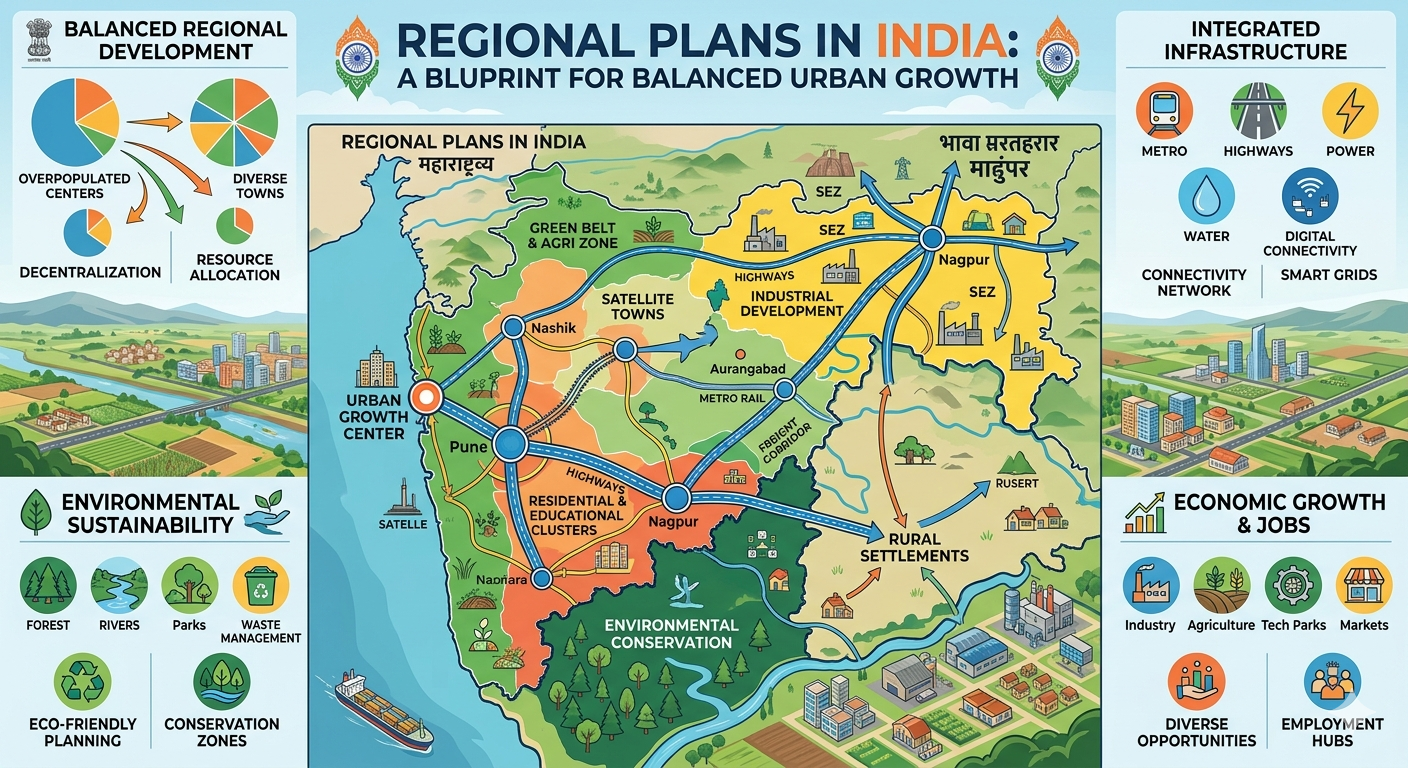
As an urban planner working in Pune, this plan is particularly relevant to your practice. Pune Metropolitan Region Development Authority (PMRDA) has been preparing a comprehensive metropolitan plan for Greater Pune, covering the rapidly urbanising areas beyond the PMC and PCMC limits. The plan addresses the explosive growth of peri-urban areas, metro rail expansion, ring road development, and industrial corridor planning in alignment with the Pune-Mumbai Expressway corridor.Conclusion: The Blueprint That Shapes Every City
A city without a master plan is like a building constructed without architectural drawings — the structure may stand for a while, but it will eventually buckle under its own contradictions. The development plan or master plan is the foundational document of urban governance. It is the product of years of data collection, analysis, design, negotiation, and public deliberation. It is the closest thing a city has to a constitution for its physical development.
In India, where urbanisation is adding millions of people to cities every year and where the stakes of poor planning are measured in floods, slums, congestion, and inequality, the master plan has never been more important. The challenge for the next generation of urban planners — and that includes you, if you are reading this — is to make master plans not just technically rigorous, but genuinely responsive,